
06:00 · Departure
What to wear on safari · Pilanesberg: Four times of day, one wardrobe.
The air temperature at 6 am roughly matches the mean daily low at the nearest weather station, and at midday the mean daily high. In an open vehicle the wind from driving comes on top: at 40 km/h, the speed limit in Nairobi, Addo and Pilanesberg, we apply the wind chill formula of the US National Weather Service. It only applies up to 10 °C and without sun, so the feels-like value only appears for cold mornings and evenings. The layers below are our rule of thumb.
06:00 · All destinations
What to wear on safari · Jul: Where safari gets coldest.
All destinations on this website in the selected month, sorted by the feels-like temperature at 6 am in an open vehicle. Above 10 °C we show the air temperature, because the wind chill formula does not apply there.
10:00 · Choosing colours
What to wear on safari · Colours: Which colour? Tap your shirt.
No park regulation prescribes khaki. There are reasons to avoid certain colours, though, and they are not the ones most guides claim.
Navy blue: Avoid where tsetse flies occur.
Blue is the most attractive colour for tsetse flies. In a study of 37 fabrics, phthalogen blue caught more flies than black (Lindh et al., 2012).
That is why tsetse traps are covered in blue and black cloth. Dark blue jeans fall right into this range.
Black: Avoid where tsetse flies occur.
The US Centers for Disease Control and Prevention (CDC) lists very dark colours as attractive to tsetse flies.
After smelling CO₂, yellow fever mosquitoes fly straight at black, red and orange (University of Washington, 2022).
White: Better than its reputation.
Tsetse flies are rarely caught on white, and yellow fever mosquitoes ignore white in the wind tunnel.
The only argument against white is dust. There is no study showing that wild animals react to white.
Khaki: The safe choice.
Earth tones hardly show dust and are not among the colours that attract tsetse flies or mosquitoes.
Khaki is not compulsory anywhere.
Olive: The safe choice.
Yellow fever mosquitoes ignore green in the wind tunnel.
No conflict with the tsetse colours blue and black.
Red: No problem for buffalo, more of one for mosquitoes.
There is no evidence that red provokes buffalo. Cattle have no dedicated red cone; Cape buffalo have not been studied.
Yellow fever mosquitoes target red after contact with CO₂.
Camouflage: Prohibited in Zimbabwe.
The German Foreign Office and the UK Foreign Office (FCDO) both state that civilians may not wear camouflage clothing in Zimbabwe. This applies to Victoria Falls and the start of the Chobe day tour.
In South Africa the army's camouflage pattern is protected. In a vehicle camouflage achieves nothing anyway, because the animals see the car.
Light blue: Take care in tsetse areas.
What matters to tsetse flies is the blue component around 460 nanometres, not how light the colour is.
Outside tsetse areas light blue is no problem.
Destinations affected
13:00 · Midday
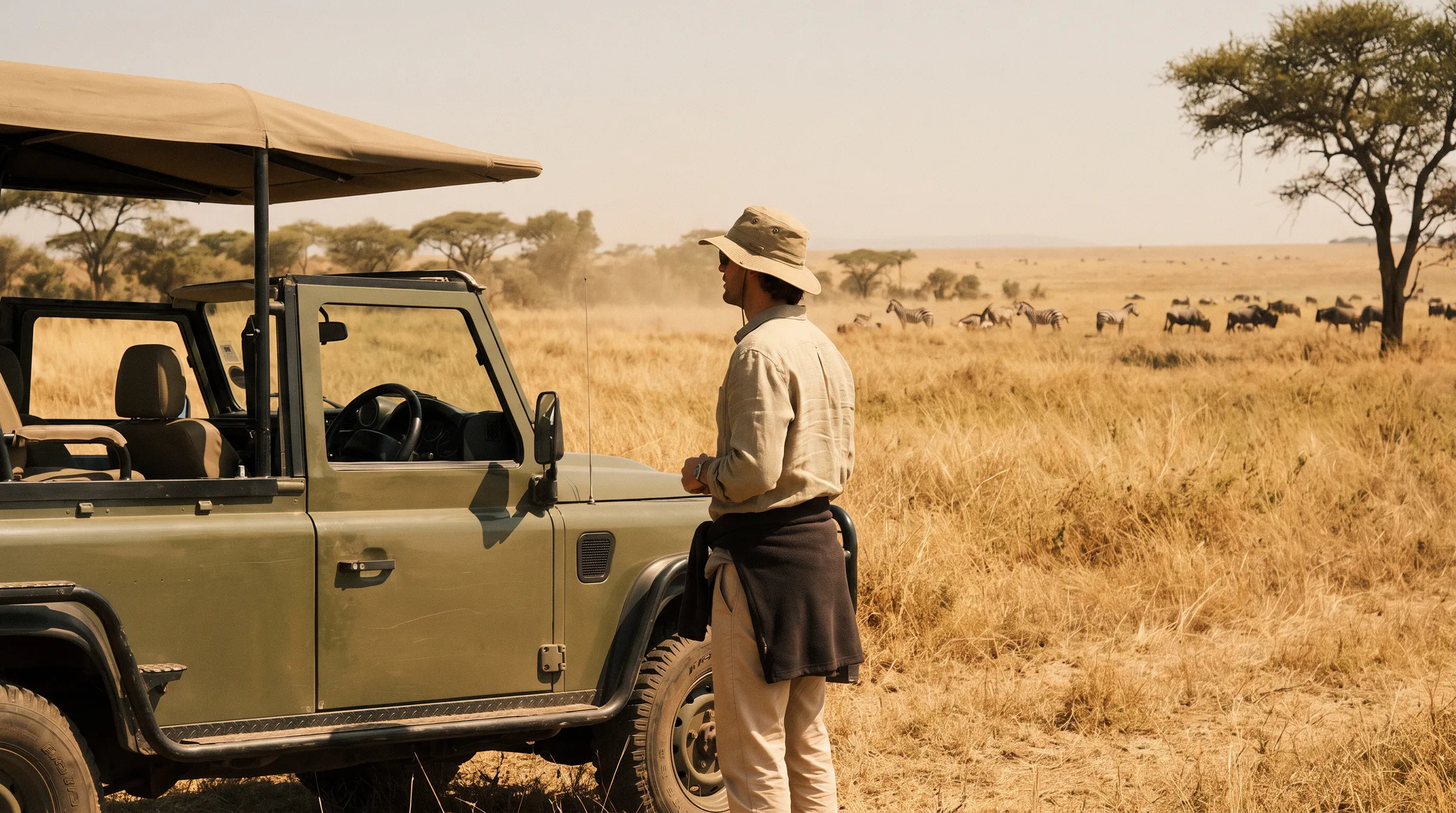
At midday only the hat matters.
On 2 October 2026 the midday UV index was 13.6 in Nairobi, 12.4 in Zanzibar and 8.0 in Cape Town. From 8 upwards the WHO advises avoiding the midday sun, which is impossible in an open vehicle. In South Africa the value varies widely: Durban averages 3.2 in June and 13.8 in January.
AI-generated illustrative image
05:30 · Packing
What to wear on safari · Packing list: The packing list for one day.
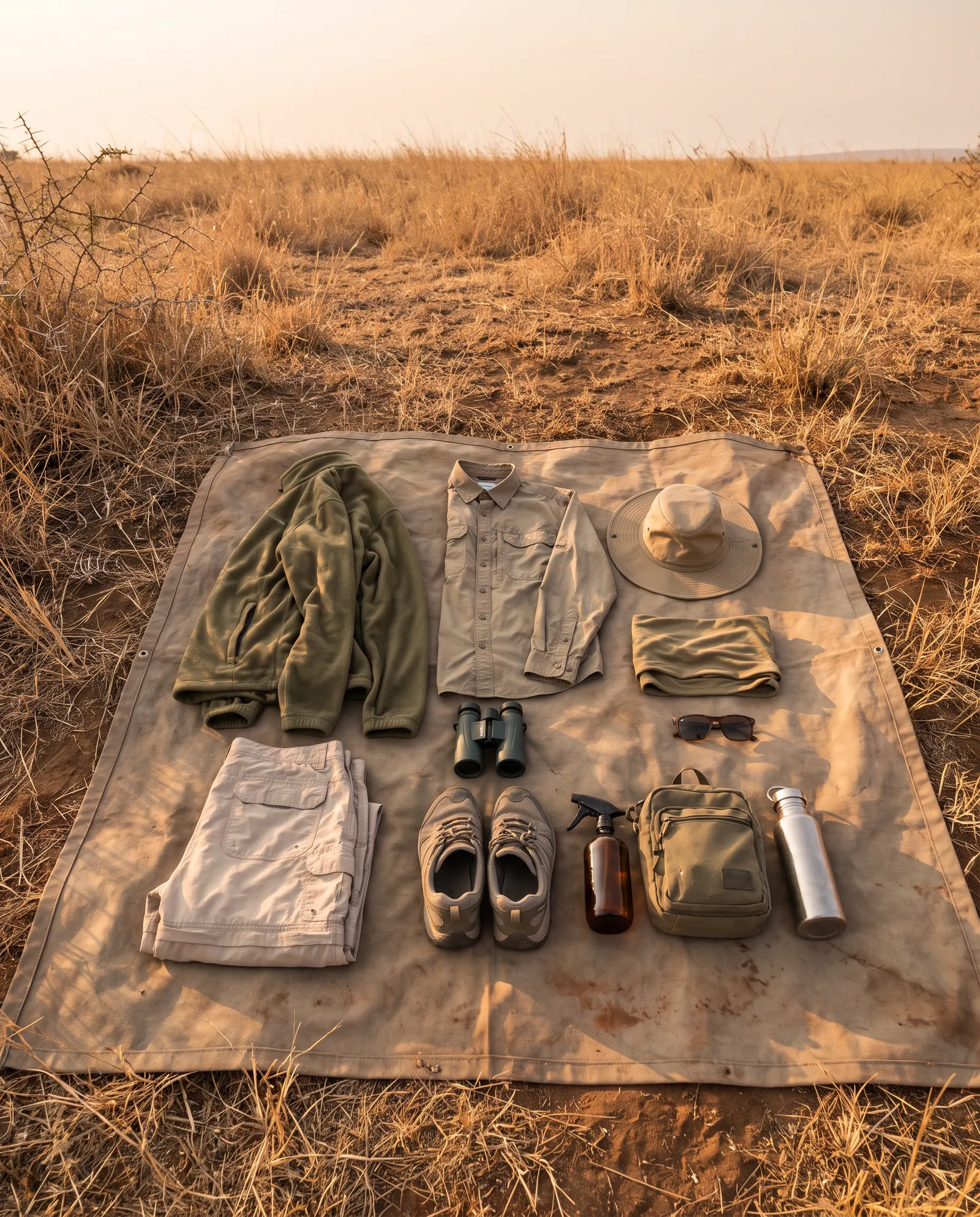
For a day safari you do not need a safari suitcase, just a soft daypack. The list applies to all destinations; where the destination matters, it says so. The links lead to a matching selection at Amazon.
- 01
Loose long-sleeved shirt
Covers your skin against mosquitoes and sun. The CDC recommends medium-weight fabric, because tsetse flies bite through thin material.
Where: all destinations; heavier fabric in Mikumi, Tarangire, Tsavo East and Hluhluwe-iMfolozi
- 02
Long, lightweight trousers, ideally zip-off
Against cold and mosquitoes in the morning and evening; at midday you can zip off the legs.
Where: all destinations; long from dusk in malaria areas
- 03
Fleece or down gilet
In July the air at Pilanesberg is 3.2 °C at 6 am, which feels below freezing in the wind of the drive.
Where: South Africa, Victoria Falls and Chobe from May to September; Nairobi a light one all year; unnecessary on the coast
- 04
Windproof packable jacket
A 40 km/h driving wind costs five to six degrees on cold mornings.
Where: all destinations with a morning game drive
- 05
Beanie, gloves and neck gaiter
Face and hands cool down fastest in the wind of the drive.
Where: inland South Africa, Victoria Falls and Chobe in winter
- 06
Brimmed hat with chin strap
The WHO advises a hat from a UV index of 3. In Nairobi it reached 13.6 at midday in early October. The chin strap keeps the hat on in the wind.
Where: all destinations
- 07
Sunglasses
Part of sun protection according to the WHO, and in an open vehicle also against dust.
Where: all destinations
- 08
High-SPF sunscreen
Sunscreen first, then insect repellent: DEET on top reduces the sun protection factor by a third (CDC).
Where: all destinations
- 09
Insect repellent with DEET or picaridin
The CDC names DEET, picaridin and IR3535 as tested active ingredients; below 10 per cent, protection often lasts only one to two hours.
Where: essential in Zanzibar, Mikumi, Arusha, Tarangire, Victoria Falls, Chobe, Kruger, Mombasa and Tsavo East
- 10
Insect-repellent clothing (permethrin)
According to the CDC it lasts through many washes, but it works only weakly against tsetse flies. Long clothing and repellent matter more.
Where: malaria destinations, optional
- 11
Comfortable closed shoes
On a game drive you stay in the vehicle. Trainers are fine, sandals are not.
Where: all destinations
- 12
Long socks
Tuck your trousers into your socks; the CDC recommends this against mosquitoes and ticks.
Where: malaria destinations
- 13
Binoculars
The animals are often far from the track. A pair with 8x or 10x magnification is enough.
Where: all destinations
- 14
Soft daypack and fabric bag
Plastic bags are banned in Kenya and Tanzania. On the light aircraft to Mikumi, 15 kg in soft bags is allowed.
Where: Kenya, Tanzania, flight from Zanzibar
As an Amazon Associate I earn from qualifying purchases. These links are advertising; the price is the same for you.
15:00 · Second round
What to wear on safari: What the guides get wrong.
"Never wear white"
White is actually favourable with tsetse (low catches) and Aedes mosquitoes (ignored). The only argument against is dust, for which no evidence was found. Whether animals react to white is not established.
"Khaki is compulsory"
No park regulations checked (KWS, North West Parks, TANAPA) prescribe colours. Earth tones make sense because of tsetse and mosquitoes, but are not required.
"Red provokes buffalo"
Cattle, goats and sheep are dichromats without a dedicated red cone, so they do not see red as a signal colour. Cape buffalo have not been studied; transferring the result from domestic cattle is plausible but unproven. A better argument against red is that Aedes mosquitoes are drawn to it.
"Camouflage is ideal"
Banned for civilians in Zimbabwe, so also for Victoria Falls guests; in South Africa the SANDF pattern is protected. In a vehicle camouflage achieves nothing anyway, the animals see the car.
"Black is banned"
No ban found. Black does attract tsetse (CDC: very dark colours) and Aedes mosquitoes.
"Safari boots or hiking boots are necessary"
On a game drive you stay in the vehicle (KWS, Pilanesberg). The CDC only recommends closed shoes rather than sandals. Boots only pay off on walking safaris.
"Africa is always hot, shorts are enough"
July mornings: Pilanesberg 3.2 °C, Victoria Falls 5.6 °C, Nairobi 10.1 °C; below zero in the headwind.
"Light colours protect against malaria mosquitoes"
Established only for Aedes in the laboratory (white, green, blue ignored) and for An. stephensi (red attractive). African malaria vectors were not tested, and they bite at night. Long clothing and repellent are more effective than colour choice.
AI-generated illustrative image
16:00 · Rules
What to wear on safari: What is banned and what is required.
Malaria and clothing
Malaria mosquitoes bite mainly in the evening and at night. Day tours often start before sunrise and sometimes end after sunset, which is exactly when they are active. In Zanzibar, Mikumi, Arusha, Tarangire, Victoria Falls, Chobe, Kruger, Mombasa and Tsavo East, pack long sleeves, long trousers, socks and repellent for the departure and the return. For Tanzania and Botswana the German Foreign Office also advises protection during the day because of day-biting mosquitoes.
Other rules
Plastic bags, Kenya. General ban, even possession is punishable, heavy fines up to prison possible; do not bring plastic bags into the country. Single-use plastic is prohibited in national parks. Pack spare clothes, shoes and snacks in fabric bags or packing cubes, not plastic bags.
Plastic bags, Tanzania and Zanzibar. General ban; plastic bags are taken off you on arrival by air. Zip bags for liquids in hand luggage are exempt. Also applies to the domestic flight from Zanzibar to Mikumi.
Dress code, Zanzibar. Shorts or sleeveless tops away from resorts, especially in Stone Town, may cause offence; authorities can fine USD 700 or more, guides and operators at least USD 1,000. Applies to the journey through town, not the park. Long, light clothing covers both.
Drones. Kenya: import and export only with approval from the aviation authority KCAA. Tanzania: in national parks only with four permits (Filming Board, Ministry of Defence, TCAA, TANAPA), otherwise penalty from USD 100 and confiscation. South Africa: SANParks permits drones in no national park, arrest and confiscation. Leave the drone at home.
Light aircraft luggage, Zanzibar to Mikumi. Coastal Aviation allows 15 kg per person including hand luggage and strongly recommends soft bags. Which airline a given day trip uses is up to the operator; other carriers have their own limits. For one day a soft daypack is enough; the suitcase stays at the hotel.
Stay in the vehicle. KWS: remain in the vehicle except in designated areas. Pilanesberg: no body parts out of windows or sunroof. Explains why hiking boots are not needed (see myths).
Camouflage by country
| Country | Banned? | What applies |
|---|---|---|
| Zimbabwe | yes | German Foreign Office: wearing camouflage clothing prohibited, reserved for the military. FCDO: illegal for civilians to wear any clothing made from camouflage material. |
| Zambia | unclear | Neither the German Foreign Office nor the FCDO mentions camouflage (as of 02.10.2026). Only secondary sources (guidebooks, blogs, Wikipedia citing Lonely Planet) state a ban. |
| Tanzania | unclear, leaning yes (military clothing) | The German Foreign Office and FCDO do not mention a camouflage ban. In August 2023 the armed forces (TPDF) ordered civilians to hand in military uniforms and "similar" items within seven days or face punishment under the law. Whether civilian camouflage prints are covered remains open. |
| Kenya | unclear | The German Foreign Office and FCDO do not mention a camouflage ban. |
| Botswana | unclear, no mention | The German Foreign Office and FCDO do not mention a camouflage ban. |
| South Africa | only the SANDF pattern | Travel advice is silent. The Defence Act 42 of 2002 prohibits unauthorised possession and wearing of the protected SANDF uniform and its camouflage pattern, up to five years in prison (report of 23.10.2025 on a crackdown on civilians). Other camouflage patterns are not covered according to the report. |
19:00 · Back at the hotel
What to wear on safari: Frequently asked questions about what to wear on safari.
What colours should you not wear on safari?
In areas with tsetse flies, avoid blue and black; this affects Mikumi, Tarangire, Hluhluwe-iMfolozi and probably Tsavo East. In Zimbabwe, which means Victoria Falls and the start of the Chobe tour, camouflage is prohibited for civilians. Contrary to many guides, white is no problem for animals or insects; it just gets dusty quickly.
What shoes should you wear on safari?
Comfortable closed shoes; trainers are fine. On a game drive you stay in the vehicle, as required for example by the Kenya Wildlife Service and Pilanesberg. Hiking boots are only worth it on a walking safari.
Can you wear shorts on safari?
At midday, yes. In the morning it is often too cold for them: in July the air at Pilanesberg is 3.2 °C at 6 am, and 5.6 °C at Victoria Falls. In malaria areas, long trousers are needed from dusk. Zip-off trousers solve both.
Are jeans okay to wear on safari?
They are not banned anywhere. Dark blue denim, however, falls right into the colour range that tsetse flies respond to most strongly, and it is heavy and slow to dry. In South Africa, Nairobi and on the coast this does not matter; in Mikumi, Tarangire, Tsavo East and Hluhluwe-iMfolozi you are better off with light-coloured fabric trousers.
What should a woman wear on safari?
The same as a man: layers in earth tones, long sleeves, long lightweight trousers, a hat and closed shoes. In addition, in Zanzibar away from the hotels, especially in Stone Town, shoulders and knees should be covered. The UK Foreign Office (FCDO) mentions fines starting at USD 700 for inappropriate clothing.
How warm should you dress for a morning game drive?
That depends on the destination and month. From May to September in South Africa, at Victoria Falls and at Chobe you need a fleece, a windproof jacket, a beanie and gloves: with a 40 km/h driving wind, 3.2 °C feels like −3.1 °C. In Zanzibar and Mombasa the monthly mean morning temperature never drops below 19 °C, so a light jacket is enough there.
Is there a dress code on safari?
None of the park regulations we checked prescribes colours. There are related rules, though: camouflage is prohibited in Zimbabwe, plastic bags are banned in Kenya and Tanzania, and a dress code applies in town on Zanzibar.
Do I need insect-repellent safari clothing?
It is not necessary. According to the CDC, permethrin-treated clothing works against mosquitoes through many washes, but only weakly against tsetse flies. Long clothing at dusk and a repellent with DEET or picaridin matter more.
Can I bring a drone?
Leave it at home. SANParks does not allow drones in any national park, Tanzania requires four permits, and Kenya requires a permit from the civil aviation authority just to import one.